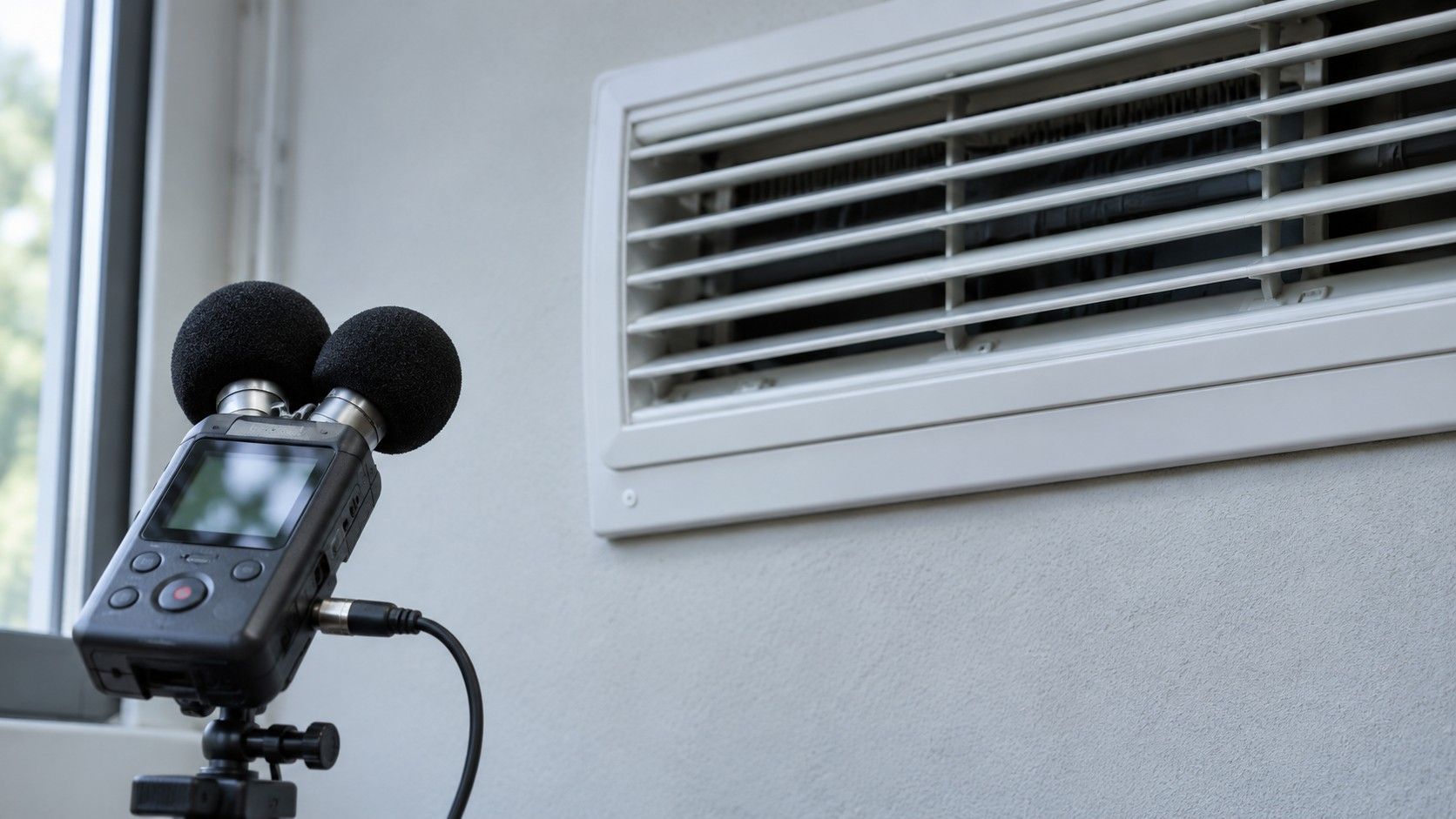
Two takes recorded minutes apart can have noticeably different backgrounds if ventilation switched on between them. When you edit across the change, the room may seem to grow or collapse even if the instruments match. Identify the two conditions before reaching for broad noise reduction. A better-matched take or one short transition usually protects more of the performance than treating the whole recording as if the room had stayed constant.
Gather short references with the unit on and off
Look for quiet parts already recorded in both conditions. Keep the microphone position and gain the same when comparing them. An interval before a take is useful if it has no guide spill or movement, while the end of the last chord may still include musical decay. Get a separate listening reference once the chord has fully finished rather than using that decay as though it were empty room sound.
Write down the time at which the ambient sound changes. A mechanical cycle can begin with a distinct thump, settle into a broad moving sound and later fade out. A transition between two different captures can involve only the sustained sound, or it can contain the whole onset. Its shape helps determine whether to wait for a more stable part of the recording or edit on another take. A short stable sample represents the floor better than an interval containing the switch itself.
Change only what you are allowed and able to change. Do not interfere with building ventilation or use unfamiliar electrical controls merely to make a recording quieter. If the room permits a normal temporary setting change, capture a new reference at otherwise unchanged settings and allow the system to settle. If it does not, note the regular pattern and plan around it rather than trying to disable necessary equipment.
Hear where the change crosses a splice
Locate the splice in the context of a musical phrase. Play from shortly before against the surrounding instruments, not only as a short loop. Sometimes the ear hears a different room more than it hears a change in average volume. A vocal pause may become dry on one side or pick up a faint broad swell at the same instant that a new word begins. A meter alone cannot confirm the flow of the ambience.
Compare the source takes independently. If one take keeps the same background, a sudden change in your edit may be caused by the units cycling in the room; it may also be caused by a processor changing behavior across different sections. Bypass unnecessary effects on a comparison version without changing the input or output gain. This can reveal whether the source floor actually changed or the edit introduced a different gating or compression decision.
Check whether the change matters at normal playback. A faint sound obvious in a soloed vocal may be masked by the full mix. But an edit exposed at a quiet breakdown can still reveal the background abruptly. Note whether the room shift continues for the rest of the take or occupies a short region. One narrow transition calls for a different decision from essentially two different recording environments.
Choose a new take or a compatible transition
If you can re-record a short part in a steady condition, consider that before processing broadly. Keep the placement and performance context as close as practical, and capture enough material before and after the replacement phrase for a clean join. Close-miking can improve the signal's relation to room noise, but moving a microphone can also change tone, distance and proximity effect. Compare the new take against the old one and keep the tone that fits the arrangement.
Where re-recording is not possible, look for two source sections whose background behavior is already similar. Try a short overlap after a consonant or under a sustained arrangement, rather than in the only silent pause. If the waves of sound conflict or the room tilts across the stereo field, move the edit before lengthening the overlap. A longer crossfade can also overlap musical hits, and hiding a room transition is not worth creating a doubled onset.
If the floor differs throughout a long section and there is no suitable donor, a gentle and localized treatment may be reasonable. Compare it against the original at a fair listening level. Before keeping it, confirm that sustained notes and room release do not begin to breathe with the process. A stable audible difference may be easier to accept than constantly shifting side effects. Keep the original in case a better source becomes available.
Avoid doubling or inventing an ambience bed
Do not lay a long recording of one ventilation state underneath the entire track merely to unify it. That creates a second bed where one already exists and can make different parts of the mix appear noisier. If using room tone as a tiny bridge, choose a compatible recording from the same microphone and condition. Fade only across the necessary interval, then listen to the result with the actual take in place.
Hear how the left and right channels behave together. A fan on one side may be balanced by other room energy on the other side. Copying or processing left and right separately can make the room pull across the stereo image. Keep reference channels aligned and audition a mono fold-down if the work needs to translate to mono. An edit should not rely on a stereo trick that creates a worse gap after summing.
A room patch should not contain movement, a fragment of music, or another audible cycle unless that event belongs in the arrangement. Avoid saving the loudest sample as a reusable noise floor just because it was easy to identify on a display. If no stable background sample exists, try another boundary or keep the more coherent section. A plausible intact recording is preferable to one assembly that advertises several small substitutions.
Review the continuous section
Listen all the way through the affected transition at a normal level. Ask whether the room remains plausible during the decay and whether a new instrument or word changes the background abruptly. Compare another section that does not contain the fault so you can hear how much ambience the song normally has. A comparison only at the noise's loudest point can lead to an overcorrection for the rest of the performance.
Export a working copy and reopen it in another player. Check that an edit intended to cover one pause does not add a silence or change the mix outside it. For a later line that still needs attention, keep the exact times and which ventilation state was audible rather than applying the same stronger setting everywhere. The best repair may be different where the ambience is masked by drums or where the arrangement is sparse.
Record what you kept: which take, any small transition and the condition of the room. Preserve the untreated files and the edit session. If another session is possible, plan around the building's regular cycle and capture enough quiet room reference in the chosen condition. The payoff is being able to edit the performance on musical grounds instead of choosing wherever the ventilation happens to be quiet.